

Ten months after the first Specialised Investment Fund (SIF) was launched, investors have a clear favourite. Total assets across all SIF strategies stood at ₹23,177.31 crore as of July 31, 2026, and ₹16,523.65 crore of that — 71 percent — sits in what AMFI calls "Hybrid Investment Strategies."
Almost all of it is concentrated in a single sub-category: Hybrid Long-Short Fund, with ₹15,373.69 crore spread across 11 schemes and roughly 41,612 folios. Its other hybrid-oriented subcategory, the Active Asset Allocator Long-Short category, has managed just ₹1,150 crore across 3 schemes and 6,782 folios by comparison. So, when money goes into a SIF today, it is usually going into a Hybrid Long-Short fund.
That tilt may not last, though. By scheme count, Equity Oriented Investment Strategies have already pulled ahead, with 16 live schemes (10 Equity Long-Short, 5 Equity Ex-Top 100 Long-Short, 1 Sector Rotation) against 14 across both hybrid categories put together. For now, hybrid still leads the AUM chart — a total AUM of ₹16,523.65 crore against ₹6,653.66 crore of Equity (Data source: AMFI Monthly SIF Report – July 2026).
The four funds we examine today are qsif Hybrid Long-Short (Quant Mutual Fund), iSIF Hybrid Long-Short (ICICI Prudential), Arudha Hybrid Long-Short (Bandhan Mutual Fund), and Altiva Hybrid Long-Short (Edelweiss) — together managing roughly ₹7,000 crore, with Altiva Hybrid occupying the largest chunk. All four operate under the same SEBI mandate: at least 25 percent in equity, at least 25 percent in debt, and an option to run up to 25 percent of net assets as unhedged shorts through derivatives. This derivative usage is what makes these funds very different from each other despite being part of the same category.
Four Funds, One Category: Strategy Comparison
| Parameter | qsif Hybrid Long-Short | iSIF Hybrid Long-Short | Arudha Hybrid Long-Short | Altiva Hybrid Long-Short |
|---|---|---|---|---|
| AMC / House | Quant Mutual Fund | ICICI Prudential | Bandhan Mutual Fund | Edelweiss Mutual Fund |
| Derivative Mandate | Directional single-stock shorts & high-conviction hedge | Long index futures offset by stock call options | 100% matched stock-for-stock short futures hedge | Cash-future arbitrage spreads & covered call |
| Net Derivative Exposure | -14.03% of NAV | -1.36% of NAV | ~0.0% net equity exposure | Spread-capture (market neutral) |
| Risk Band (SEBI) | Level 3 | Level 5 | Level 1 | Level 1 |
| Benchmark Risk Band | Level 2 | Level 2 | Level 2 | Level 2 |
| Core Return Driver | Directional short alpha + concentrated equities | High gross equity (~66%) with light option overlays | High-grade corporate debt & CDs (~59%) | Arbitrage spreads (37%) + fixed income (40.7%) |
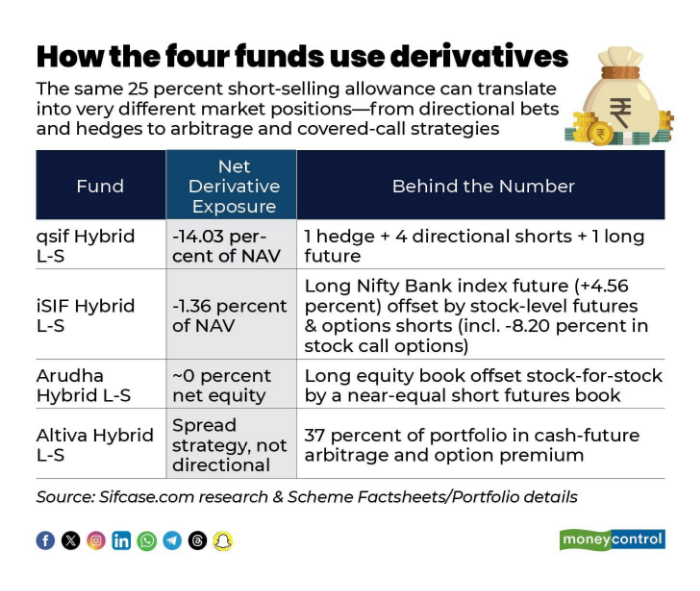
How Each Fund Uses Its 25% Unhedged Short Allowance
SEBI gives every Hybrid Long-Short fund the same 25 percent short allowance. It is what each manager actually does with that freedom that makes these four funds so different:
- qsif (Quant Mutual Fund): Entire derivative book is six stock futures: four outright directional shorts with no offsetting long (Bajaj Finance, Cipla, Eicher Motors, Biocon), one genuine hedge (-8.59% short in Adani Energy Solutions against an 8.58% long in the same stock), and one long bet (UPL). Net derivative exposure: -14.03% of NAV.
- iSIF (ICICI Prudential): Only index future is a +4.56% long in Nifty Bank — a bet on rising markets. But a -8.20% net short through stock call options, plus scattered stock-level futures shorts, more than cancel it out. Net derivative exposure: -1.36% of NAV.
- Arudha (Bandhan Mutual Fund): Uses its entire short allowance purely for hedging: a 38.29% long equity book offset stock-for-stock by a -38.41% short futures book, leaving almost no net equity exposure.
- Altiva (Edelweiss): Approach is different: 37% of the portfolio — most of its derivative book — sits in cash-future arbitrage and covered calls, built to capture spreads rather than take directional market bets.
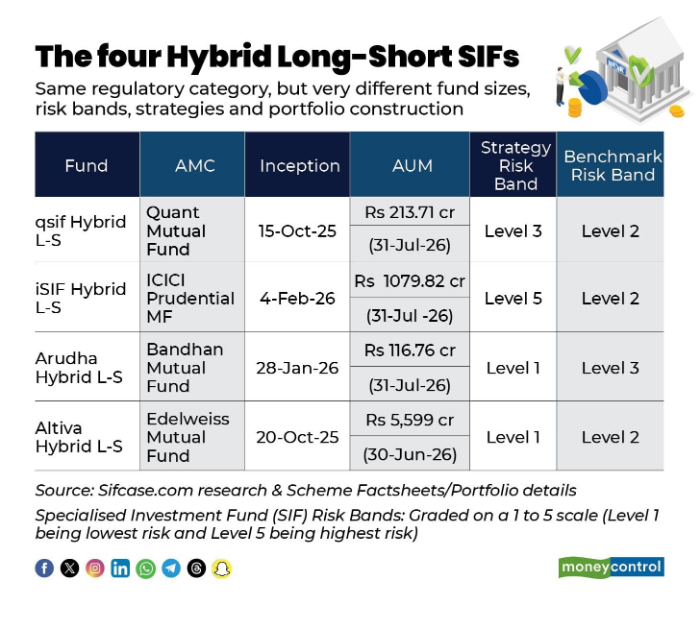
Different Risk Bands Within the Same Category
Because of these derivative architectures, risk bands diverge widely:
- iSIF's high net equity exposure and long index futures put it at the highest risk band of the four, Level 5 — though its benchmark sits three notches lower, at Level 2.
- qsif's mix of hedge and directional bets lands it at Level 3 — while its benchmark is at Level 2.
- Arudha and Altiva share the lowest band, Level 1 — both being on lower band levels compared to their respective benchmarks.
Inside the Portfolios
- Altiva (Edelweiss): The largest and most granular fund. Holds positions in equity across 60-plus names, none above 2.47%. Portfolio allocation consists of 37% cash-future arbitrage & covered calls. Fixed income adds 40.74% (1.62-year duration, 7.85% yield), plus 4.10% in REITs/InvITs.
- Arudha (Bandhan): A 38.29% equity book across 30-plus names (none above 1.63%) is almost fully cancelled by its own short futures. The real driver is debt: 59.32% in high-grade corporate bonds and commercial paper.
- qsif (Quant): The least diversified: 11 stocks plus one REIT make up 39.36% of NAV. Adani Energy Solutions alone is 8.58% — the largest single bet here, though largely hedged. Another 10.26% sits in four InvITs; the rest — roughly half the fund — is debt, money-market paper and cash, including 26.98% in TREPS.
- iSIF (ICICI Pru): The most conventionally equity-like: 66.24% gross equity across ~55 stocks, with debt component of 33.66% (2.48-year duration, 6.79% yield). TVS Motor, the largest holding, is just 4.11% of NAV.
Let the Category Label Not Mislead You
All four funds operate under the same SEBI rules: minimum 25 percent equity, minimum 25 percent debt, and up to 25 percent unhedged short exposure. Yet, each has a very different story and portfolio construction:
"Arudha has hedged its equity book down to almost nothing, so the risk you are actually taking on sits mostly in its bonds, not its stocks. Altiva is not making a directional call — instead its returns come from arbitrage spreads, covered calls, and fixed income. iSIF, on the other hand, comes closest to a conventional high-beta equity fund with a light derivative overlay, while qsif sits at the opposite extreme: four separate directional short bets stacked next to one hedge, built more for conviction than caution."
None of that shows up in the name. "Hybrid Long-Short" tells you what SEBI lets these funds do — it does not tell you what the manager actually chose to do with that freedom. That is where an advisor helps you choose the correct product suitable for your risk profile.
Editorial & Regulatory Disclaimer:This article is published for educational and informational purposes only and does not constitute personalised financial or investment advice. Past performance is not indicative of future market results. Readers are advised to consult a SEBI-registered financial adviser before making any investment decisions.