

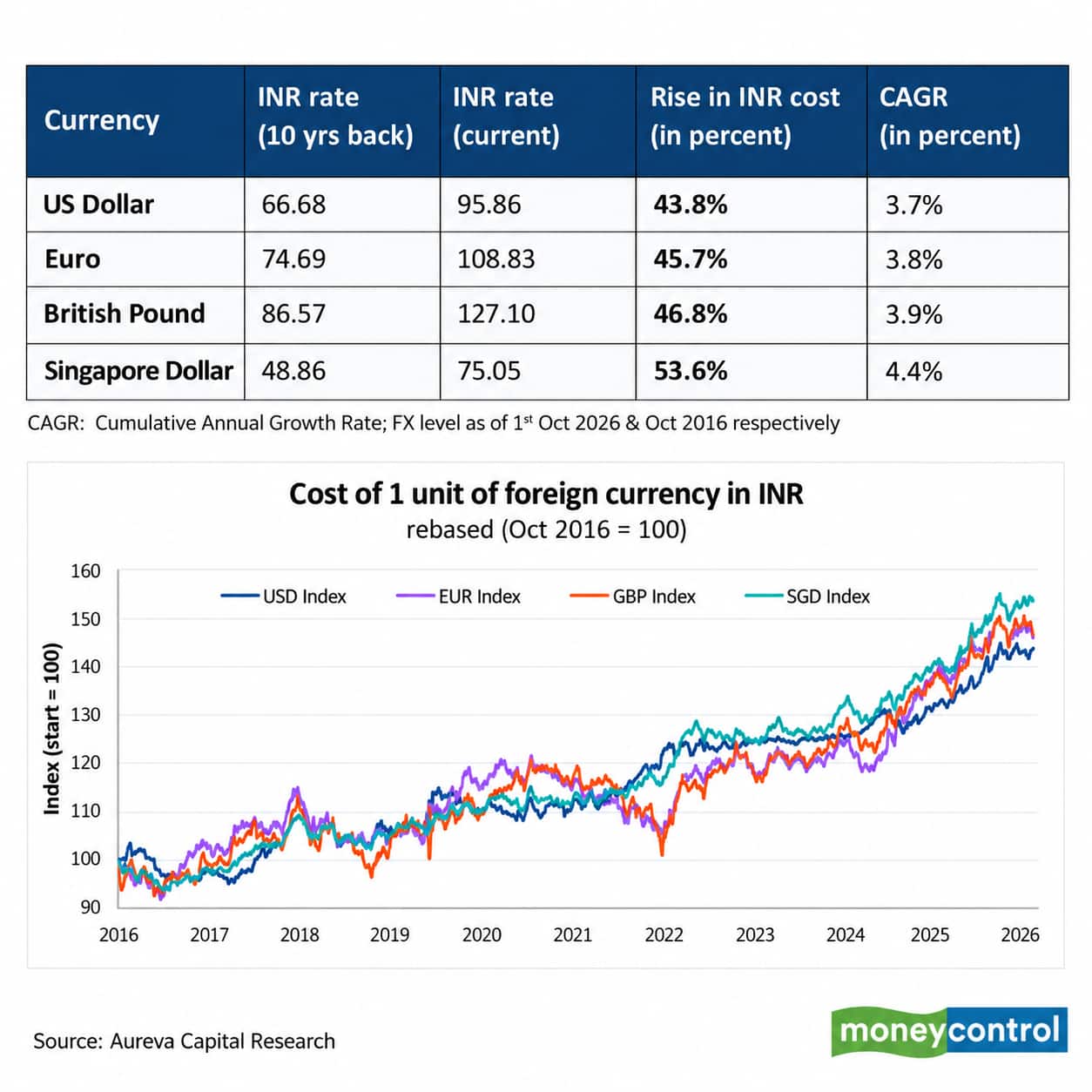
The Nifty 50 has navigated macro headwinds, Brent crude remains volatile above $100 a barrel, and the Indian rupee has steadily depreciated against the US dollar over the past decade — sliding from ₹66.7 to over ₹96 per dollar. Yet domestic investors remain overwhelmingly concentrated in Indian assets: while foreign portfolio investors (FPIs) pulled out over $24 billion during global reallocation cycles, domestic institutional investors (DIIs) poured in over $60 billion.
At the same time, Indian families increasingly have global goals — from funding children's university education abroad to international travel, global healthcare, or overseas residency. Holding a dedicated portion of family wealth in foreign-currency assets helps fund these commitments without bearing the persistent compounding drag of a depreciating domestic currency.
Why the Traditional Global Routes Have Had Limitations
Historically, investing abroad from India was fraught with regulatory friction and structural bottlenecks:
- Domestic Mutual Fund Overseas Cap Reached: Indian mutual funds investing in overseas equities share an industry-wide $7 billion RBI cap. Whenever this aggregate quota fills up, AMCs are forced to pause fresh inflows and SIPs, frustrating systematic long-term compounding.
- Direct Overseas Brokerages Bring Tax Headaches: Opening an overseas trading account allows direct stock selection, but triggers exhaustive annual Schedule FA and Schedule FSI reporting in Indian income tax filings.
- The Punitive US Federal Estate Tax Trap: Under US Internal Revenue Code regulations, non-US residents holding US situs assets directly (such as US-listed shares or US ETFs) face a draconian 18% to 40% US Estate Tax on assets exceeding just $60,000 upon demise — an existential wealth-transfer risk that few families plan for.
The GIFT City Breakthrough: A Regulated, Dollar-Denominated Route
This is where GIFT City (Gujarat International Finance Tec-City) transforms global investing. India's sole International Financial Services Centre (IFSC) operates under a single, unified statutory regulator — the IFSCA — which consolidates the jurisdictions of RBI, SEBI, IRDAI, and PFRDA.
Entities operating in GIFT IFSC are treated as non-resident for foreign-exchange purposes under FEMA, unlocking critical advantages for domestic Indian investors:
- Invest Entirely in US Dollars: Remittances flow seamlessly under RBI's Liberalised Remittance Scheme (LRS), are converted to USD, and remain invested in dollar-denominated global instruments.
- Outside the $7 Billion Mutual Fund Cap: GIFT City fund structures are offshore vehicles not constrained by the domestic mutual fund overseas quota.
- Shielded from US Federal Estate Tax: Because the GIFT City fund vehicle holds the underlying US securities while the investor holds units in the IFSC fund, individual investors generally remain outside the direct US estate tax jurisdiction.
- Institutional Tax Efficiency: Most GIFT City fund structures manage tax obligations at the vehicle level or provide streamlined reporting, eliminating personal foreign tax credits filings.
Three Core Reasons to Look Beyond an India-Only Portfolio
| Comparison Parameter | India-Only Portfolio | Globally Diversified Portfolio (via GIFT City) |
|---|---|---|
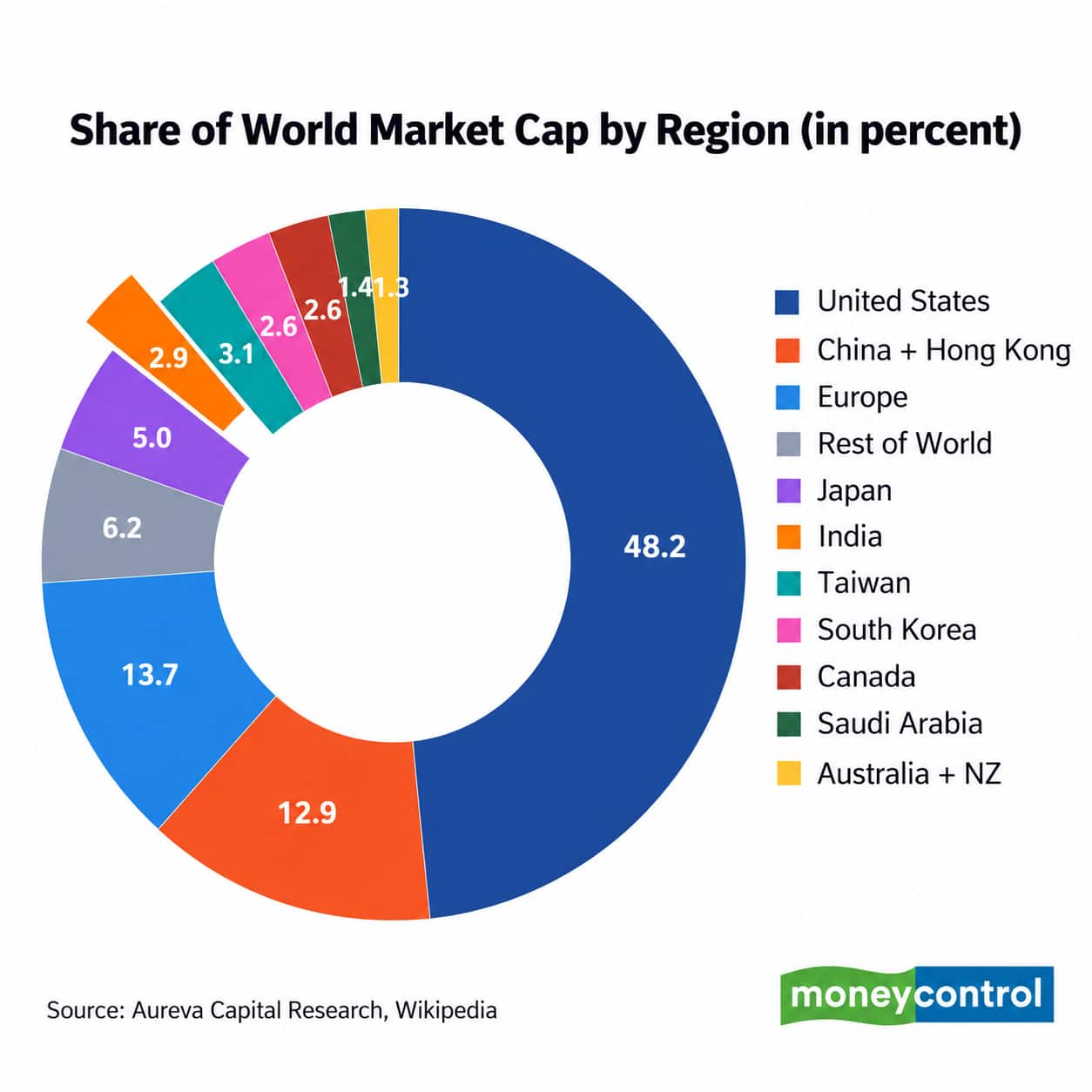
| Global Listed Equity Reach | Covers only ~2.9% of global market cap ($4.95T of $171.6T) | Directly accesses the remaining ~97.1% of global equity |
| Currency Exposure | 100% INR-denominated; INR has lost ~3.7% p.a. vs USD | Hard-currency USD compounding cushions purchasing power |
| Geographic Concentration | 100% tied to single domestic economy & regulators | Diversified across US tech, Europe, Japan, and global themes |
| Overseas Education Cost | Effective ~6.8% CAGR compounding cost in INR terms | Directly funded in USD, absorbing only ~3% organic tuition inflation |
| Global Leadership Rotation | Subject to Indian economic and sector cycles | Captures whichever international market or sector leads |
Reason 1: You May Be Investing in Just 3 Percent of the World
India's share of global listed equity is approximately 2.9 percent, with Indian equities accounting for about $4.95 trillion out of the $171.6 trillion global market capitalisation. This means that roughly 97.1 percent of the world's listed equity market lies outside India.
An India-only portfolio represents significant concentration in a single economy and currency. Global diversification unlocks access to secular themes unavailable on domestic exchanges — including leading semiconductor foundries, generative AI infrastructure, global enterprise SaaS, innovative oncology biotechnology, and deep US private credit markets.
Reason 2: Your Global Goals Are Compounded by Currency Depreciation
Consider what currency depreciation means for a global aspiration such as international higher education:
- Assuming US tuition fees rise at a modest 3 percent annually, a $50,000 fee in 2016 becomes approximately $67,196 by 2026 — an increase of 34.4 percent in dollar terms.
- However, over that exact decade, the USD/INR exchange rate climbed from 66.68 to 95.86 — a 43.8 percent increase (3.7% CAGR).
- In rupee terms, the cost of that same education expense rocketed from ₹33.34 lakh in 2016 to ₹64.41 lakh in 2026 — an explosive 93.2 percent increase (6.8% CAGR)!
"Funding dollar liabilities with rupee earnings forces investors to constantly fight an uphill currency battle. Direct allocation to USD-denominated assets eliminates this structural drag."
Reason 3: Global Market Leadership Keeps Rotating
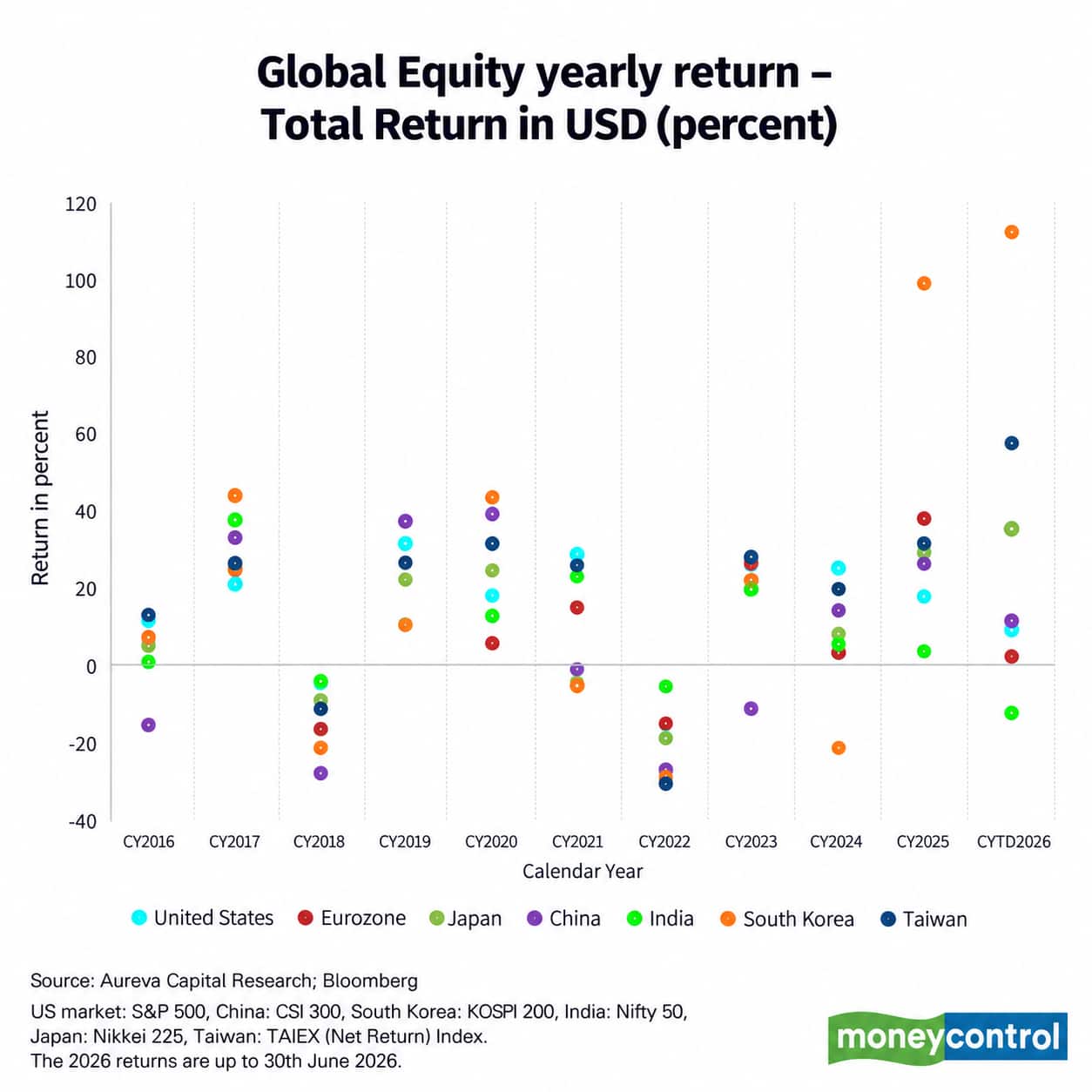
No single geography or stock market wins continuously. Over the past decade, market leadership has rotated from US Big Tech to Indian infrastructure, Japanese manufacturing, European luxury, and global dividend champions.
A globally diversified allocation ensures that your family portfolio captures alpha from whichever market is in the lead, smoothing volatility across multi-year cycles.
How Indian Investors Can Access GIFT City Funds
Indian resident individuals can invest in GIFT City funds via the RBI Liberalised Remittance Scheme (LRS):
- LRS Limit: Up to $250,000 per person per financial year (a family of four can remit up to $1,000,000 annually).
- Tax Collected at Source (TCS): Remittances above ₹10 lakh attract 20% TCS, which is fully adjustable against final income tax payable or refundable during tax filing.
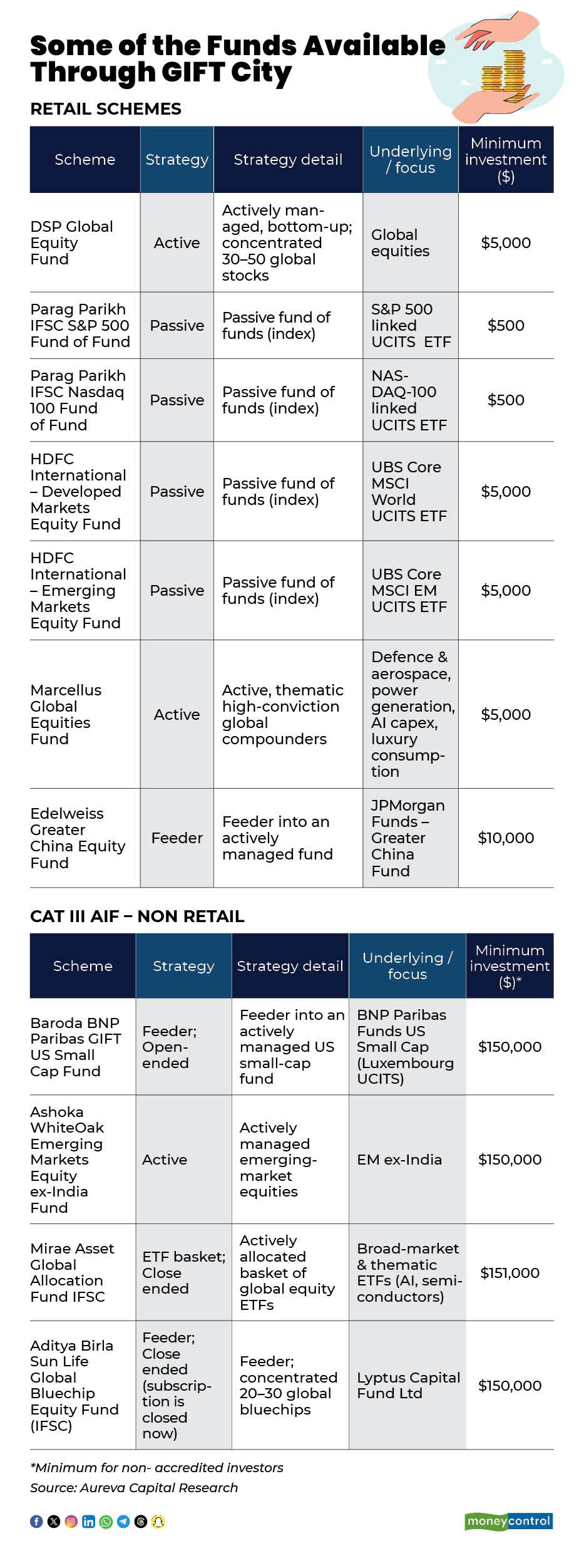
- Retail Schemes: Open to all investors, with minimum investment tickets as low as $500 to $5,000, offering access to global indices and active multi-asset portfolios.
- Restricted Schemes (Category III AIFs): Designed for accredited and high-net-worth investors with minimum thresholds of $150,000, providing exposure to global hedge funds, private credit, and venture capital.
Conclusion
An India-only portfolio covers about 3 percent of the world's listed equity, in a currency that has historically depreciated against the US dollar. GIFT City provides Indian families a regulated, dollar-denominated route to the other 97 percent.
The question is no longer whether to look beyond India — it is about how much to allocate to fund global goals and protect multi-generational purchasing power.
Editorial & Regulatory Disclaimer:This article is published for educational and informational purposes only and does not constitute personalised financial or investment advice. Past performance is not indicative of future market results. Readers are advised to consult a SEBI-registered financial adviser before making any investment decisions.